Professional Guide · Eyelash Extensions
Understand how fiber diameter, fan construction, and the client's natural lashes correlate.
Volume technique is not just about creating a fuller result. It is about building controlled, symmetrical fans and adapting the total weight to each natural lash.
Reading time: approximately 9 minutes · Updated July 27, 2026

In short
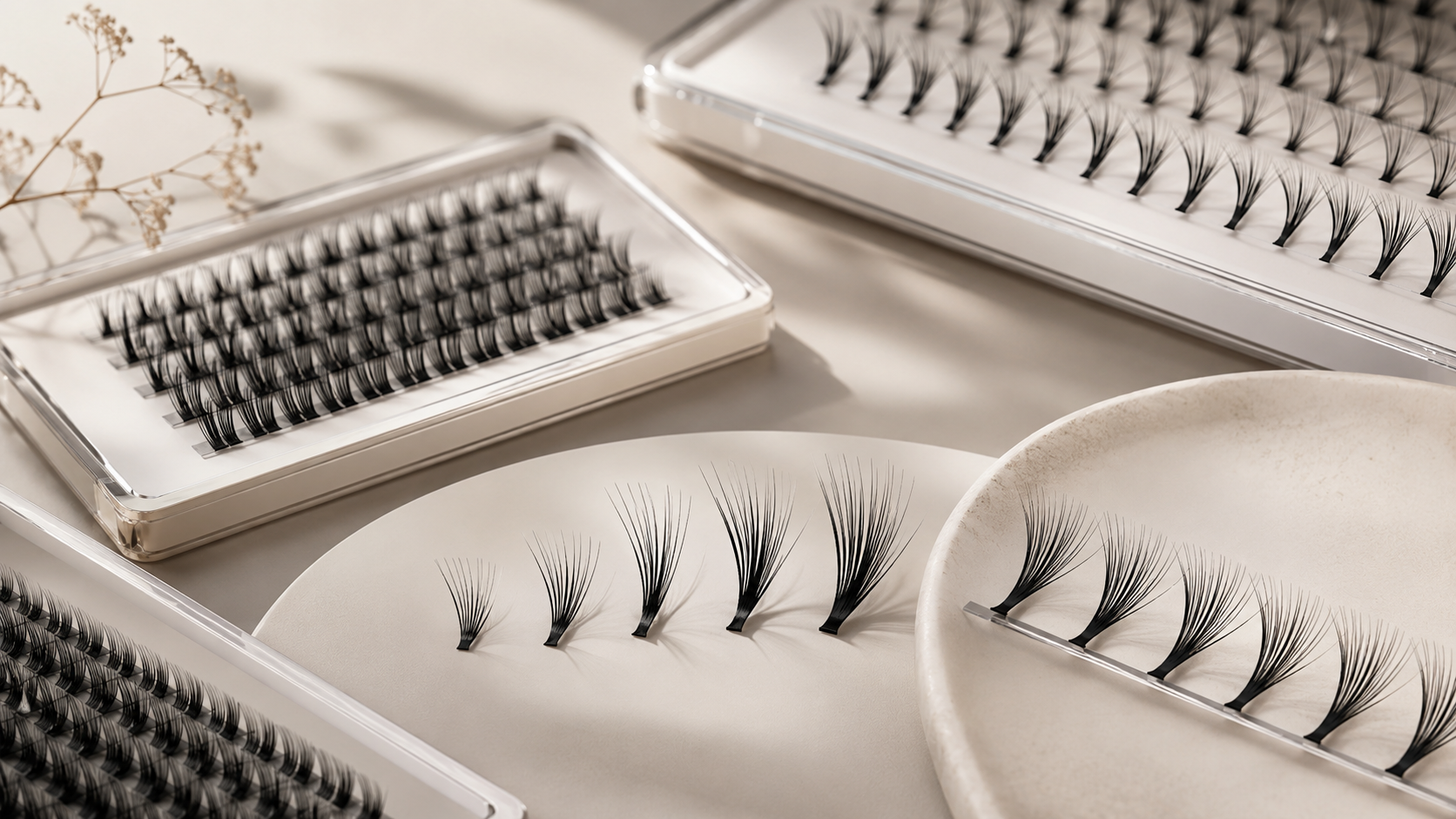
A volume fan consists of several very thin extensions gathered into a common base and applied to an isolated natural lash. Generally, the thinner the fiber, the more fibers can be included in the fan – but the correct dimension is always determined by the natural lash's condition, the fan's width, length, and total weight.
The Basics
What are volume lashes?
In classic lash extensions, one extension is typically applied to one natural lash. In volume technique, the stylist instead shapes a fan of several thinner fibers. This makes it possible to fill gaps, control density, and create everything from a soft, airy result to a more defined look.
Volume lashes should not automatically be equated with heavy or very dramatic sets. A well-planned treatment can be soft and natural. The difference lies primarily in the construction and the ability to control density, texture, and shape.
Three factors determine a good volume fan
An even base
The fibers need to meet in a controlled base that makes placement stable and easy to direct.
Symmetrical spread
The distance between the fibers affects whether the fan is perceived as narrow, wide, compact, or airy.
Customized total weight
Diameter, length, and number of fibers must be assessed together based on the natural lash.
0.03, 0.05, or 0.07 mm?
The thickness describes the diameter of the individual fiber. The table is a practical guide based on Bellestore's current product information – not a universal weight calculation.
| Thickness | Typical application | Working characteristics | Keep in mind |
|---|---|---|---|
| 0.03 mm | Ultra mega volume according to product use | Very thin and light fiber for experienced volume stylists | Requires great control over the fan's base and symmetry |
| 0.05 mm | Mega- and nano volume according to product information | Thin fiber that allows for dense yet light constructions | Choose fan size based on the natural lash – not just desired density |
| 0.07 mm | Russian volume and classic volume technique | Slightly sturdier fiber that is often easier to control | Fewer fibers may be needed as the diameter increases |
Workflow for a well-planned volume set
-
1
Analyze the natural lashes
Assess strength, length, growth direction, and density before choosing dimension and design.
-
2
Plan your mapping
Determine how lengths and directions should be distributed across the eye before starting the application.
-
3
Choose diameter and fan width
Base it on the natural lash and the desired look. Do not confuse high density with high weight.
-
4
Build and place consistently
Keep the base, spread, glue amount, and direction consistent throughout the entire treatment.
-
5
Check the separation
Finish with a careful check to ensure no natural lashes are stuck together.
Current volume lashes at Bellestore
Three fiber diameters for different working methods. The products are shown as educational choices, not as a ranking. Price and stock checked July 27, 2026.


Common mistakes in volume technique
Too much focus on the number of fibers
More fibers are not a quality metric. Total weight, symmetry, and the capacity of the natural lash are more important.
Uneven or split bases
An unstable base makes placement more difficult and can create an uneven overall impression.
The same design for all clients
Eye shape, lash line, and the direction of the natural lashes need to guide mapping and length choices.
Lack of isolation
The volume fan must be placed on an isolated natural lash. Check the separation systematically.
Frequently asked questions about volume lashes
What is the difference between single lashes and volume lashes?
Classic technique typically uses one extension per natural lash. Volume technique uses a fan of several thinner fibers on an isolated natural lash.
Which thickness should I choose for volume lashes?
It depends on the natural lash, the planned size of the fan, and the desired result. 0.03 and 0.05 mm are very thin options, while 0.07 mm is slightly sturdier. Always assess the overall construction.
What are hybrid lashes?
A hybrid set combines classic single extensions with volume fans. It can provide more structure than a pure volume set and more density than a classic set.
Are volume lashes always more dramatic?
No. The fan's width, density, length, curl, and mapping determine the look. Volume technique can be used for both soft and defined results.
How do I choose curl and length?
Base it on the natural lashes' direction, eye shape, and planned mapping. Read the in-depth guide on curl, thickness, and length.