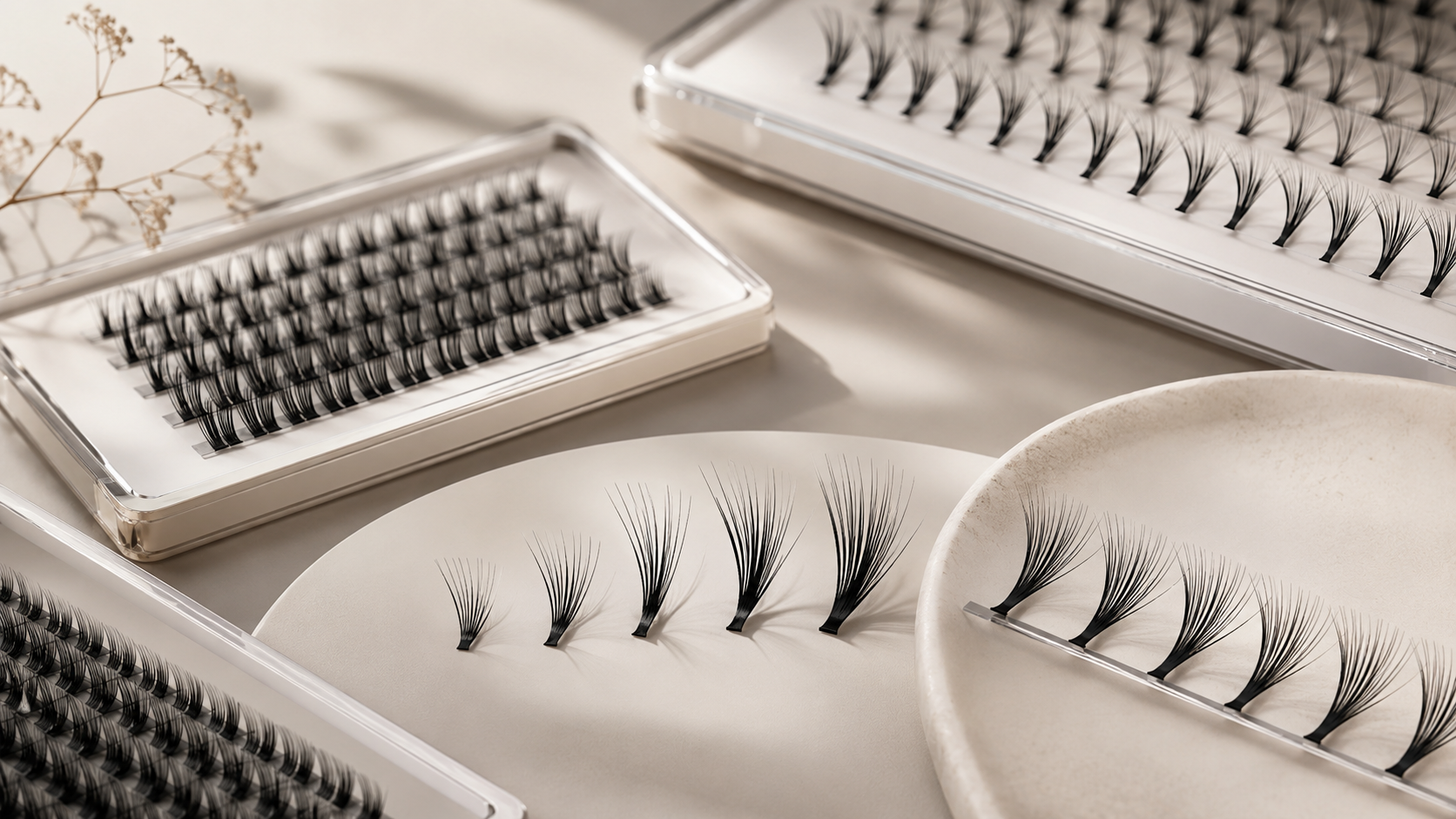
A well-thought-out lash map helps you create a balanced result based on eye shape, natural lashes, and the client's desired look.
Estimated reading time: 9 minutes · Updated July 25, 2026

Four common base shapes
Natural Eye
Follows the natural shape of the lash line and provides soft transitions.
Doll Eye
Longest in the center for a more open and rounder expression.
Cat Eye
Increases towards the outer corner and requires the right support in the outer lashes.
Squirrel
The longest zone is placed before the outer corner for a lift without a heavy outer edge.
Assess before you draw
- Identify the eye's highest point and the direction of the outer corner.
- Assess the placement of the eyes, their shape, and visible asymmetries.
- Check the length, direction, and strength of the natural lashes.
- Determine the desired look together with the client.
- Adjust the right and left eye separately when needed.
Bellestore Expert Tips
Visual symmetry does not require identical numbers
Small differences in zone placement or length may be necessary for two naturally different eyes to be perceived as balanced.
Step by step
- Analyze eye shape and facial features.
- Select the effect and define the highest point of the design.
- Mark the center, outer zone, and transitions on the eye pads.
- Distribute lengths in soft steps.
- Select curl and thickness based on the natural lashes.
- Check the map from multiple angles.
- Document the map for the follow-up appointment.
Common mistakes
| Mistake | Risk | Correction |
|---|---|---|
| Same map for everyone | The design works against the eye shape. | Start from the individual's proportions. |
| Too long outer edge | The eye can look dragged down. | Move the highest point inward. |
| Large length jumps | Uneven silhouette. | Use softer transitions. |
Recommended products
Mapping accessories
See current price and availability on each product page.


Frequently asked questions
What is the difference between cat eye and squirrel?
Cat eye increases further out, while squirrel reaches its highest point earlier and is shortened at the very end.
Should both eyes have the same map?
Not always. Small adjustments can provide better visual symmetry.
How do I choose the right length?
Start from the strength of the natural lash, the proportions of the design, and the client's goal.